
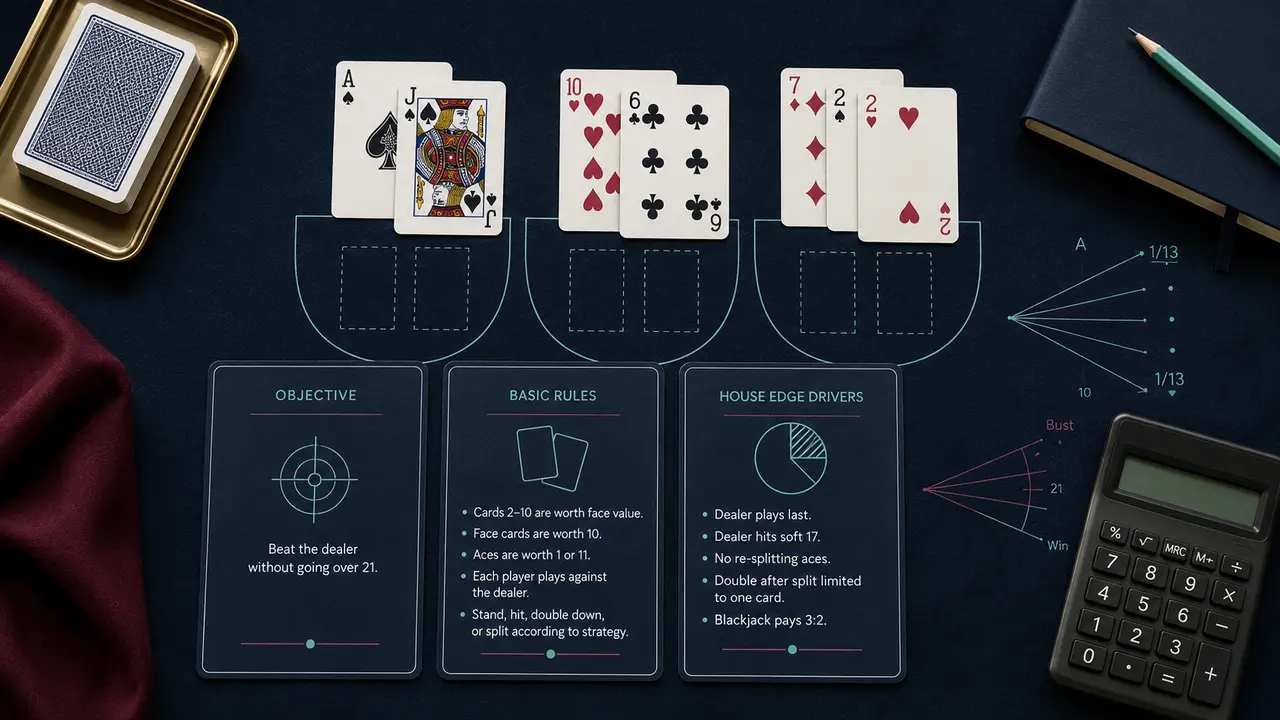
Blackjack is partly a game of chance and partly a game of fixed decisions. The cards are random, while choices such as hit, stand, double or split affect the theoretical return under a particular ruleset.
This article provides general information, not legal or financial advice. Casino UK Blog does not operate gambling services or link to casino operators.
The objective and basic flow
The aim is to finish closer to 21 than the dealer without exceeding it. Number cards keep their value, face cards count as ten and aces can count as one or eleven. A natural blackjack usually receives a special payout, but the exact amount must be checked.
Rules that matter
Whether the dealer hits or stands on soft 17, whether doubling after a split is allowed, the number of decks and the blackjack payout all affect the maths. A 6:5 blackjack payout is generally less favourable than 3:2. Side bets have separate paytables.
Basic strategy is rules-specific
A strategy chart sets out the mathematically preferred decision for each player hand against each dealer up-card. It cannot predict the next card or eliminate the house advantage. Use a chart designed for the exact table rules, not a generic claim from an advertisement.
Avoid loss-recovery systems
Progressive staking systems change the size of wagers but cannot change the probability of the cards. Table limits and finite budgets make long progressions particularly risky. Decide the maximum total spend in advance and never borrow to continue playing.
Quick checklist
- Check the blackjack payout
- Note the soft-17 rule
- Treat side bets separately
- Avoid progressive staking
The bottom line
Good decisions begin with verified information and firm personal limits. Check official sources, read the exact rules that apply and remember that no casino game provides a reliable way to make money. If gambling stops feeling manageable, step away and use the support options in our responsible-gambling guide.