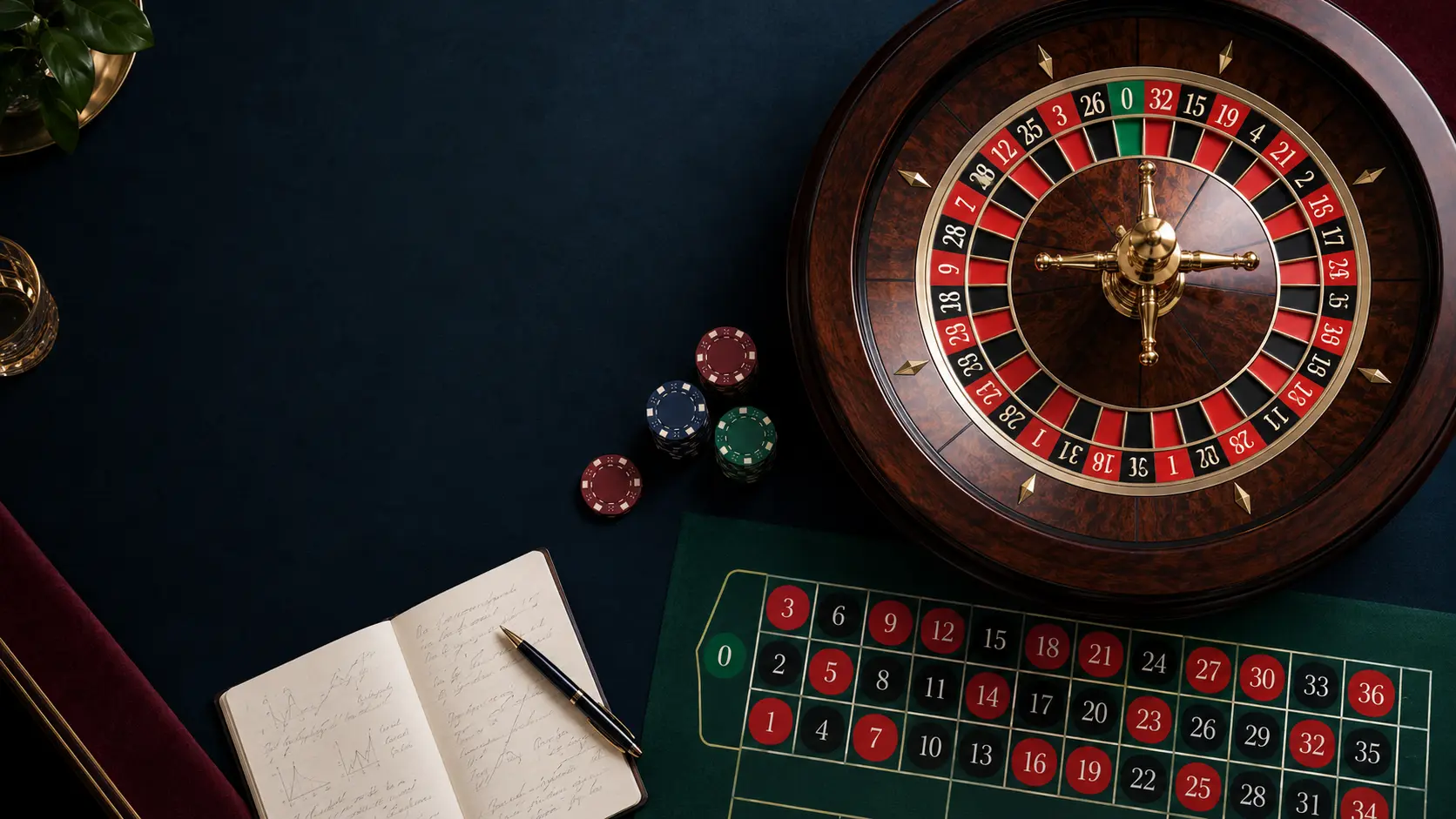
UK roulette odds are simple once you separate three different ideas: the number of pockets covered, the advertised payout and the house edge. This guide puts all three side by side.
Roulette rules in the UK: the short version
A roulette round begins when players place chips on a numbered betting layout. The wheel is spun in one direction and the ball in the other. When the ball settles in a pocket, bets that include that number win and all other bets lose. Online random-number-generator roulette presents the same wager types in software, while live dealer roulette streams a physical table.
The most common UK game is European roulette, which uses 37 pockets: 18 red, 18 black and one green zero. Some sites also carry American roulette, which adds a green double-zero pocket and has 38 possible outcomes. That extra pocket makes a meaningful mathematical difference, so checking the wheel before staking is more useful than studying a betting “system”.
Each spin is independent. The wheel does not remember earlier colours or numbers. Five reds in a row do not make black more likely on the next spin, and a number that has not appeared recently is not “due”. A results history describes the past; it cannot predict the next independent outcome.
Complete roulette payouts and odds table
The following figures apply to a standard single-zero European wheel. “Payout” means profit relative to the winning stake: a £1 bet paying 35:1 returns £35 profit plus the original £1 stake. The probability column is the chance that one spin lands on a covered number.
| Bet | Numbers covered | Payout | Chance of winning | Example £1 total return |
|---|---|---|---|---|
| Straight up | 1 | 35:1 | 1/37 = 2.70% | £36 |
| Split | 2 | 17:1 | 2/37 = 5.41% | £18 |
| Street | 3 | 11:1 | 3/37 = 8.11% | £12 |
| Corner | 4 | 8:1 | 4/37 = 10.81% | £9 |
| Six line | 6 | 5:1 | 6/37 = 16.22% | £6 |
| Dozen | 12 | 2:1 | 12/37 = 32.43% | £3 |
| Column | 12 | 2:1 | 12/37 = 32.43% | £3 |
| Red/black | 18 | 1:1 | 18/37 = 48.65% | £2 |
| Odd/even | 18 | 1:1 | 18/37 = 48.65% | £2 |
| Low/high | 18 | 1:1 | 18/37 = 48.65% | £2 |
Inside bets cover one number or a small group on the numbered grid. They win less often but pay more when they land. Outside bets cover larger groups such as red, black, a dozen or a column. They win more often but return less profit. On ordinary European roulette, neither category has a long-term mathematical advantage: the standard house edge is normally the same 2.70%.
How to calculate roulette wheel odds
For a single spin on a fair European wheel, divide the number of winning pockets by 37. A corner covers four numbers, so its chance is 4 ÷ 37, or about 10.81%. A dozen covers 12 numbers, so its chance is 12 ÷ 37, or about 32.43%.
The same method explains why a 35:1 straight-up payout is not “true odds”. With 36 losing pockets for each winning pocket, fair odds would be 36:1. The game pays 35:1 instead; that difference funds the house edge.
Odds on 0 in roulette—and why green matters
On European roulette, the odds on zero are exactly the same as the odds on any individual number: 1 in 37, or approximately 2.70% per spin. A £1 straight-up bet on zero pays £35 profit and returns the original £1 stake, for £36 in total.
The phrase “roulette green odds” can mean two things. On a European wheel, the chance of any green result is 1/37 because zero is the only green pocket. On an American wheel, both 0 and 00 are green, so the chance of green is 2/38, or 5.26%.
Zero is especially important on even-money bets. Red and black look like a 50–50 choice, but zero belongs to neither colour. A red bet therefore has 18 winning pockets and 19 losing pockets. The same is true for black, odd, even, low and high.
| Wheel | Total pockets | Green pockets | Standard house edge |
|---|---|---|---|
| European | 37 | 0 | 2.70% |
| American | 38 | 0 and 00 | 5.26% |
A single-zero wheel therefore offers better theoretical value than a double-zero wheel. That does not make it profitable or predictable; it simply means the expected loss is lower over a very large number of equal-sized wagers.
Roulette sectors explained
Roulette sectors group numbers that sit beside one another on the physical wheel, not numbers that look close on the table layout. They are sometimes called racetrack or French bets. An online game may display them through a racetrack-shaped menu.
- Voisins du Zéro covers 17 pockets around zero, normally using nine chips across several splits, a trio and a corner.
- Tiers du Cylindre covers 12 pockets opposite zero, normally with six split bets.
- Orphelins covers eight pockets not included in the two larger sectors, normally using five chips.
- Jeu Zéro is a smaller zero-area selection covering seven pockets, normally using four chips.
Sector bets can make a multi-number wager quicker to place, but they do not reveal where the ball will land. Returns also depend on which component of the sector wins because the chips are divided among several straight, split, trio or corner bets. Always inspect the game’s paytable and the total stake shown before confirming.
Roulette house edge: what the percentage means
The house edge is the game’s theoretical average advantage over a very large number of rounds. Standard European roulette has a 2.70% edge. In simple expected-value terms, staking £100 across many ordinary European roulette bets corresponds to a theoretical average loss of £2.70—not a promise that one session will lose exactly that amount.
Short-term results can sit far above or below the average because roulette is volatile. A player may win quickly, lose quickly or finish close to even. The percentage becomes more representative only across a huge sample of wagers, which is why playing longer does not “beat” the edge.
American roulette’s additional double zero increases the standard edge to 5.26%. The five-number 0–00–1–2–3 basket bet is worse again, with a house edge of 7.89%. For that reason, wheel type and paytable matter more than choosing a lucky number.
La partage and en prison
Some single-zero tables use French rules on even-money bets. Under la partage, half of an even-money stake is returned when zero lands. En prison may hold the stake for the next spin instead. When applied in the usual form, these rules can reduce the house edge on qualifying even-money bets to about 1.35%.
These rules are not available on every table and may be implemented differently. Do not assume they apply because the game is labelled European or French; open the rules panel and confirm which bets qualify.
Do roulette betting systems change the odds?
No staking pattern changes the underlying probability of the next spin. Martingale, Fibonacci, Labouchère and similar systems rearrange the size and timing of bets. They cannot remove zero, change the payout table or turn independent spins into predictable events.
Progressive systems can also increase stakes rapidly after losses. A sequence can reach the table limit or exhaust a budget before a recovery win appears. A sensible budget, a fixed stop point and small stakes are more useful controls than a promise of guaranteed returns.
How to read a UK online roulette game before playing
- Check the licence. Confirm the operator in the UK Gambling Commission public register rather than relying on a logo alone.
- Count the green pockets. Prefer a single-zero wheel if comparing standard European and American versions.
- Open the paytable. Check payouts, minimum and maximum stakes, sector-bet chip counts and any special rules.
- Look for la partage. If offered, verify exactly how it applies to even-money wagers.
- Set limits first. Decide a spending limit before the first spin and never chase losses.
Roulette rules and odds: quick questions
What are the odds of one number in UK roulette?
On a European wheel, one number has a 1/37 chance, or approximately 2.70%. On an American wheel, one number has a 1/38 chance, or approximately 2.63%. Both normally pay 35:1, which is why the American version has the higher overall house edge.
Is zero odd or even?
Neither. Zero is also neither low nor high and is not part of the red or black groups. Unless a special rule applies, an even-money bet loses when the ball lands on zero.
Does covering more numbers improve roulette odds?
It increases the chance of at least one covered number winning, but it also requires more stake or produces a smaller payout. Covering additional pockets does not remove the standard house edge.
Are roulette numbers arranged in numerical order?
No. The physical wheel uses a deliberate non-sequential order intended to distribute colours, high and low numbers, and odd and even numbers. European and American wheel sequences are different.
Which roulette bet wins most often?
Among standard single wagers, red/black, odd/even and 1–18/19–36 each cover 18 of 37 pockets, giving a 48.65% chance. You can cover more pockets with multiple wagers, but the total stake and possible net return change too.
The bottom line
For UK roulette, the useful numbers are 37 pockets, 35:1 for a straight-up winner, 48.65% for an even-money bet and a 2.70% standard European house edge. Zero is the reason common bets fall just short of a true 50–50 chance. Sector bets change coverage, not the mathematics.
Knowing the probabilities will not predict a spin, but it does make game labels and payouts easier to judge. If you want a deeper comparison of European and American wheels, read our original UK roulette odds and house-edge guide.